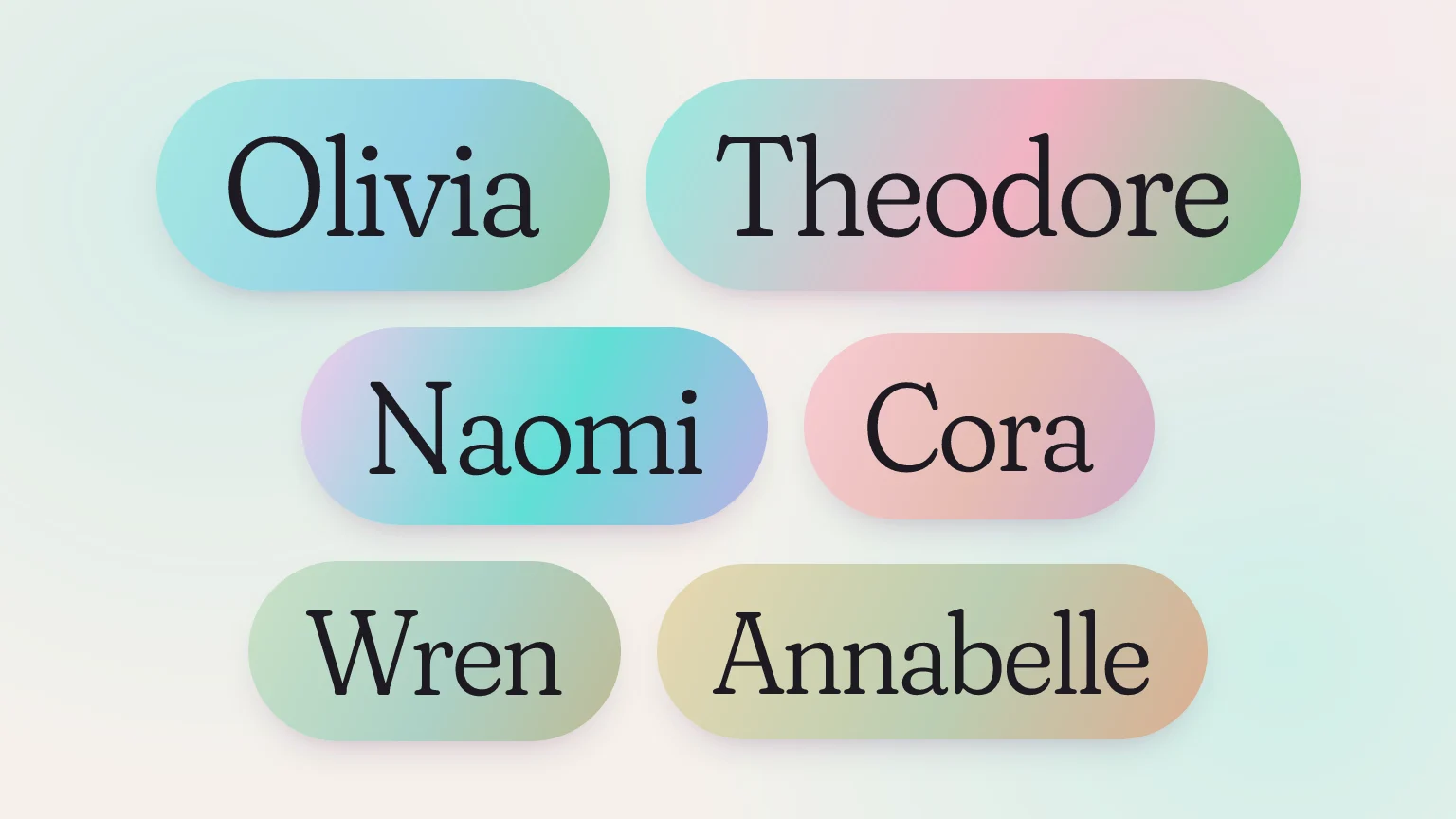
Almost every parent asks the same question at some point: will my child be one of five with this name? The honest answer depends on three things: how many babies get the name, whether that number is climbing or falling, and who your child will actually spend time with. Rank alone tells you very little about any of them.
The US counts below come from the Social Security Administration’s yearly name file, which is the data behind this site. You can read how we use it on the methodology page.
Start with 1 in N, not rank
A rank says where a name sits in a list. “1 in N” says how common it is. On Vowel’s name pages, the number counts close spellings together, so Sophia and Sofia count as one name. Here is how it looks for a few names in 2025, with the chance that another child in a class of 25 shares the name:
- Liam: 1 in 157 US babies, about a 1 in 7 chance in a class of 25.
- Olivia: 1 in 231, about 1 in 10.
- Naomi: 1 in 649, about 1 in 28.
- Cora: 1 in 1,041, about 1 in 44.
- Annabelle: 1 in 3,036, about 1 in 127.
- Louise: 1 in 5,725, under 1 in 200.
The class odds assume 24 classmates born in the same year with names drawn at random from the national list. Real classrooms differ, but the figures give you a sense of scale. Even for Liam, the most common boys’ name in the country, the chance is about one in seven.
Today’s top names are not yesterday’s top names
Names at the top of the list are far less dominant than they used to be. According to AARP’s summary of the Social Security list, the ten most common names covered 7.4 percent of boys and 6.4 percent of girls in 2025, compared with 25.6 percent and 16.5 percent fifty years ago. Sherwood News adds that after 2021, no single girls’ name made up more than 0.5 percent of US births.
Put in terms of a childhood, using the same name file:
- Robert in 1925 went to 60,895 boys, about 1 in 18.
- Mary in the 1880s went to about 1 in 14 girls, and Jennifer in the 1970s to about 1 in 27.
- Liam in 2025, the top boys’ name, went to 20,818 boys, about 1 in 82.
- Olivia in 2025, the top girls’ name, went to 13,544 girls, about 1 in 119.
A parent who worries about a name that every classmate shares is picturing the 1970s. The numbers for 2025 are much friendlier. That does not make popular names a free pass, since a name can still feel crowded in a school or a neighborhood, but it shows why the instinct to avoid the top ten is weaker than it sounds.
Direction matters more than rank
Two names at the same rank can feel completely different, because one is rising and the other is fading. Compare the number of babies now with the number ten years ago. Each name page shows the curve and where the name is projected to be in five years.
Falling from the top. Olivia has been the top girls’ name for seven straight years, according to AARP, yet 19,729 girls received it in 2015 and 13,544 in 2025, about a third fewer. Jacob was the top boys’ name of the 2000s, given to about 1 in 73 boys. In 2025, 6,152 boys were named Jacob, about 38 percent of the 2015 number. Madison ranked second among girls in the 2000s, at about 1 in 96, and has since lost more than 40 percent of its babies. Jessica led the 1980s at about 1 in 37 girls, and in 2025 just 424 girls received it.
Rising. Theodore went to 13,355 boys in 2025, roughly three times as many as ten years earlier. Wren reached 1,331 girls, up by a factor of about 3.4, and Cillian 595 boys, up nearly five times. A name that grows that fast will feel more common in a classroom in 2030 than its rank suggests today.
What does this mean for a decision? A name that is falling will feel more familiar to adults and more dated to children. A name that is rising will feel fresh now and ordinary a few years later. A steady name will feel the same.
Names that fell and came back
Popularity runs in long waves. Eleanor went to roughly 1 in 158 girls in the 1910s, fell to about 1 in 6,000 in the 1980s, and in the 2020s is back to about 1 in 230. Hazel went from roughly 1 in 111 in the 1890s to about 1 in 14,000 in the 1980s, and then to about 1 in 266. If you love an old name, its curve tells you whether it is already on its way back. The curve is on each name page. You can also see your own name’s life, then and now, with the wrapped tool, or browse names close to a favorite in style on the galaxy.
Spelling does not change the sound
Changing a spelling to avoid the crowd mostly changes the paperwork. Classmates will still hear the same name, and your child will spell it out for life. It also changes how popular a name looks. Sophia went to 12,561 girls in 2025 and Sofia to 8,252, so each looks smaller on its own than the name does to everyone who hears it. Taken together, they come to about 1 in 158 babies. If you are comparing two spellings, Sophia or Sofia shows both counts side by side.
A way to decide
- Name your tolerance. Would one other child with the name in the class be fine? Two? Use the class odds above to see what each level of risk means.
- Check the direction. Look at the ten-year change, not just the rank.
- Look at the whole curve. A name that has been around for a century will not date itself the way a spike does.
- Think local. National figures hide pockets. Ask yourself how many people you already know with the name.
- Say it with the rest of the name. A common first name with an uncommon middle name is still distinctive. See how to choose a middle name.
If you like a name but worry it is too common, the exercise is not about finding a number that passes. It is about knowing which cost you are willing to carry. For a broader method, see how to choose a baby name.
When you are ready to see how your own list stacks up, take the style quiz to see which names fit your taste, then check each one’s numbers on its name page.