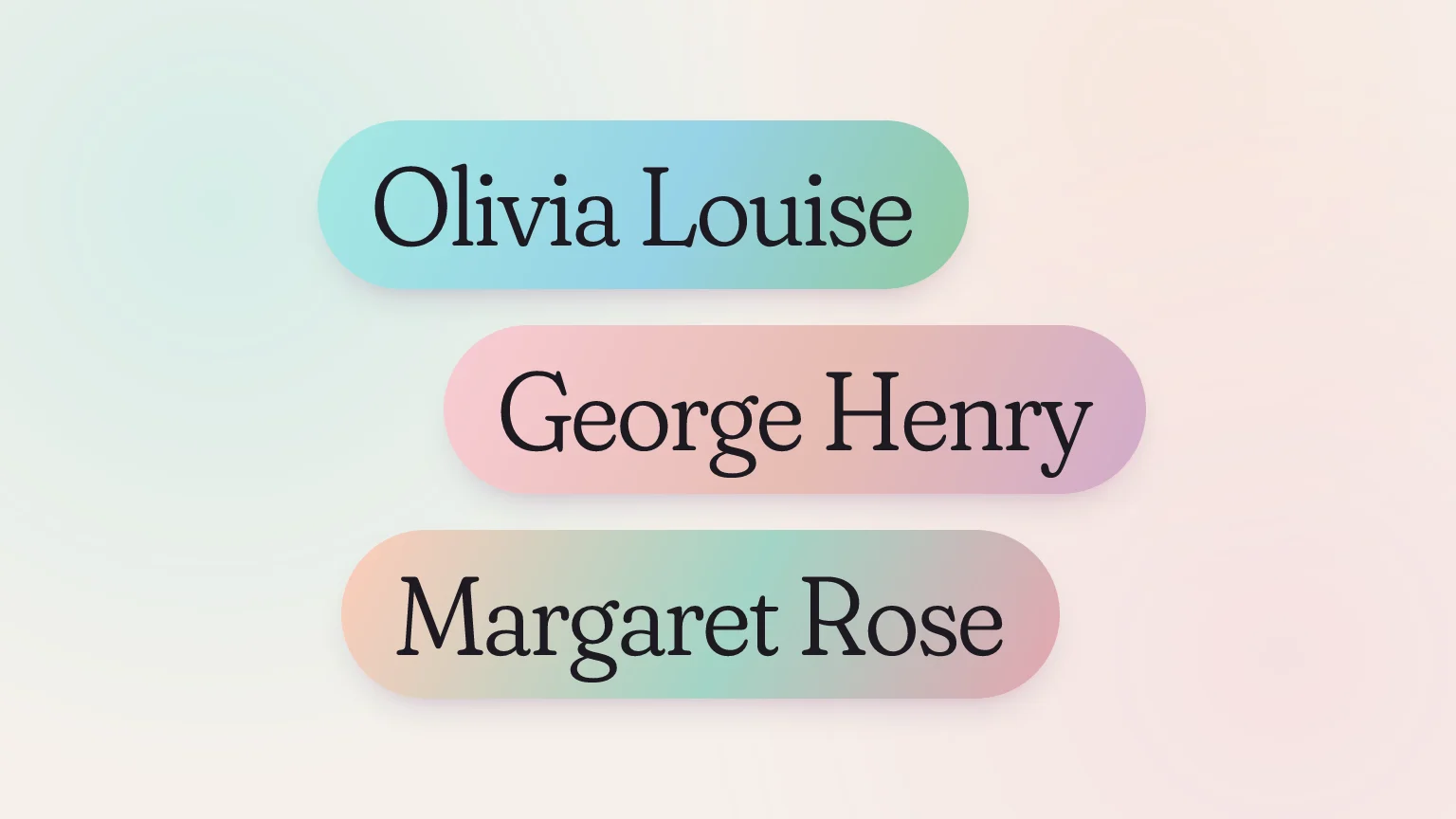
The middle name is the part of the name most parents choose last and most people say least. It still earns its place. It gives the full name its rhythm, it is where a grandparent’s name can live without taking over the everyday name, and it is the one slot where you can be sentimental or playful at no risk to the first name.
Lamaze’s guide for parents lists the usual sources: the names of relatives, maiden names, nicknames, and names with a personal meaning, such as a tree, a flower, a constellation or a hometown. Here is a five-step way to sort through them.
1. Decide what the middle name is for
A middle name usually has one of four jobs:
- To honor someone. A grandparent, a friend, a hero.
- To balance the rhythm. A short name after a long one, or the reverse.
- To carry a meaning. A place, a season, a word you love.
- To stay in reserve. A second option the child can grow into.
Pick the job first. A name chosen to honor someone is judged on love, not on flow, and asking one name to do both jobs is how couples get stuck. If honoring is the goal, our guide to honoring a family member walks through the options.
It also helps to check what the slot means where you live. According to Wikipedia, English-speaking countries sometimes use a relative’s forename as a middle name, while in Russia the middle name is a patronymic built from the father’s first name. A family with roots in two places may have two ideas about what a middle name is.
2. Match the rhythm
Say the full name aloud and tap out the beats. Two patterns almost always work: a short middle name after a long first name, and a longer middle name after a very short one. Emma has two beats, so Vowel’s middle names for Emma suggest both a single beat to finish (Grace, Rose, Kate) and a longer, rolling finish (Josephine, Caroline, Matilda). For Henry, the one-beat endings Charles, George and James lead the list.
Be careful with two names that rhyme or end alike. Ella Stella and Mia Lia sound like a nursery chant, not like a person.
3. Check the join
The join is the place where the first name ends and the middle name begins, and it is where the voice trips. Three joins cause most of the trouble:
- A vowel running into a vowel. Mia Ava and Emma Eliana blur into one long vowel sound, so listeners may not hear where one name stops.
- The same sound on both sides of the join. Evelyn Nora slides together at the n.
- The same first letter. Some families like the echo, and it is a matter of taste. Vowel’s middle name pages skip it by default, because it can sound like a stutter.
Those are the rules behind the pages themselves: a different rhythm, a different first letter, and a clean join. They are a good checklist for any name you find elsewhere.
4. Read the initials
Write the initials of the first, middle and last names, then read them as a word and as letters. Lamaze puts it simply: ask whether the initials spell something that could cause embarrassment. If you are considering two middle names, check both orders, because the initials change with the order. Look at the email-style version too, such as first initial plus surname.
5. Let the family name fit, or bend it
The middle slot is the classic place for a family name, including a maiden name or a mother’s surname. If the name you want does not flow, you have options before giving it up:
- Use a related form. Vowel’s name page for Margaret lists Margot, Maisie, Greta and Maggie as forms of the name, plus Pearl, which echoes its meaning. A grandmother who was Margaret might be honored by Margot in the middle.
- Use the cross-gender form. For George, the page lists Georgia, Georgiana and Georgina.
- Use an equivalent from another language. George is Jorge in Spanish and Georges in French, and Vowel’s page links to each.
- Use the initial only. A middle initial can honor someone quietly.
If you are choosing among several relatives, you are not limited to one. Some families give two middle names, one from each side, and others save a name for the next child.
6. Think about how the pair stands together
A popular first name does not stop a middle name from being distinctive. By the site’s count, Olivia went to 1 in 231 US babies in 2025, which gives about a 1 in 10 chance of another Olivia in a class of 25. Louise went to 1 in 5,725, which puts the chance of a classmate under 1 in 200. A rare middle name will not change the first name’s odds, but it makes the full name yours. Our guide on how popular is too popular explains how those numbers work.
7. Test the whole name together
Take your two or three finalists and say the full name three ways: in a neutral voice, called from the stairs, and introduced to a stranger. One baby name guide suggests mocking up the name on a birth announcement, in different typefaces, and leaving yourself a voicemail with the name to hear which sounds get lost. Then sleep on it. The name that still sounds right after a few days is usually the one.
There is a longer version of this check in how to test a baby name before you decide. Vowel’s decision tools include middle names and a full name view with your surname, so you can try the combinations side by side.
If you are still choosing the first name, the style quiz is a good place to start, and your results can guide the middle name too.