If your child will have two languages, two sets of grandparents or two passports, the name has more work to do. It has to be said, spelled and understood in more than one place. A name that sounds soft in one language can be hard to pronounce in the other, or mean something you did not intend.
There are three kinds of solutions, and a checklist for catching the problems.
Option 1: The same spelling in both languages
Some names are written identically in several languages. Vowel’s name pages list the languages in which each spelling is in use. Among the 25 most common girls’ names of 2025, 14 are in use in both Spanish and French as spelled: Olivia, Emma, Amelia, Mia, Isabella, Evelyn, Sofia, Eliana, Ava, Aurora, Camila, Nora, Penelope and Chloe. For boys, 12 of the top 25 are: Noah, Oliver, Mateo, Lucas, Benjamin, Elias, Luca, Sebastian, Samuel, Leo, Daniel and Julian.
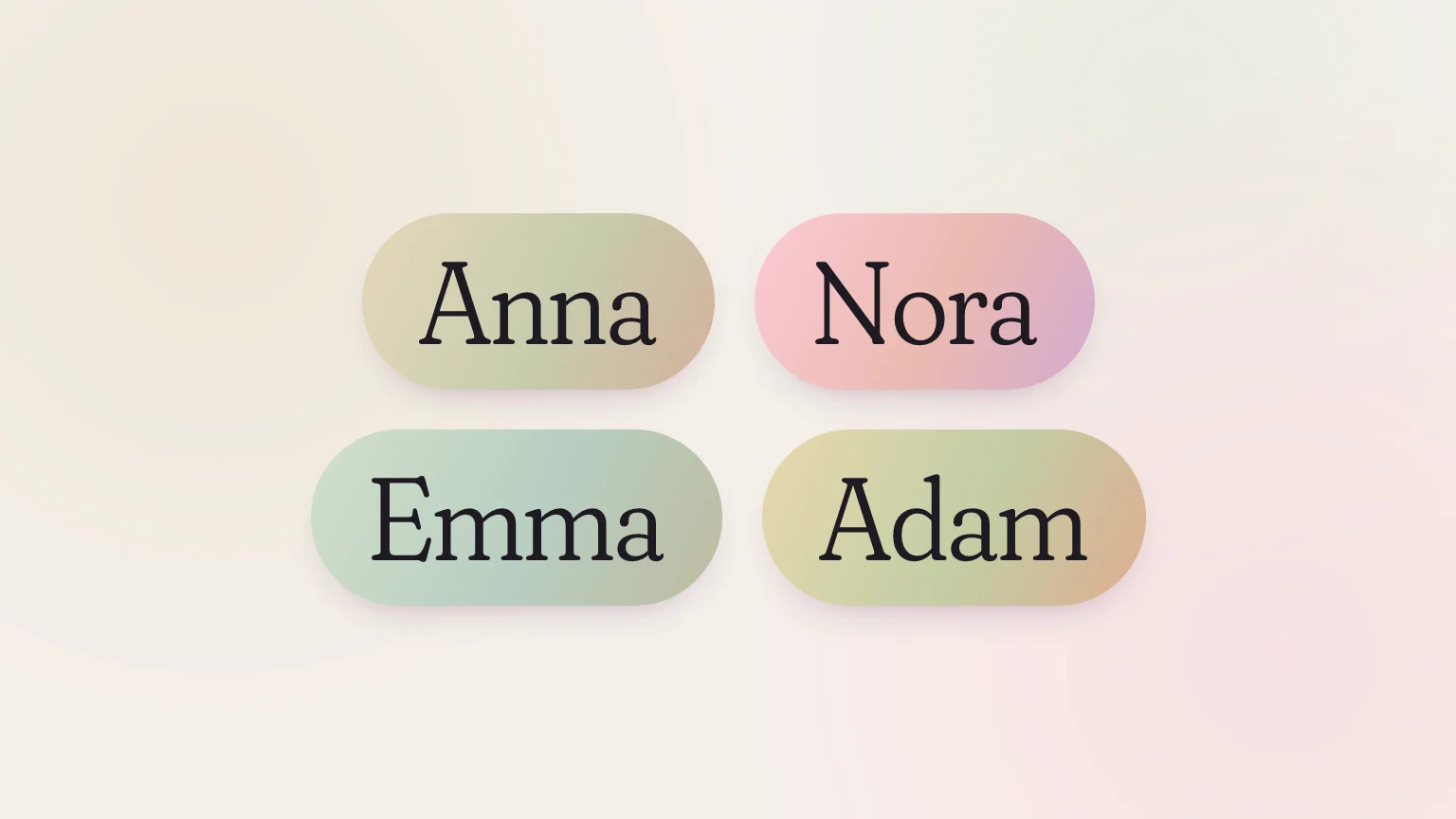
Some names go much further. By Vowel’s data, Anna is in use in 21 languages, and Nora and Adam in 17 each. A name like that is hard to get wrong on a form anywhere.
One caution: the same spelling does not guarantee the same sound.
Same spelling, different sound
Spelling travels better than pronunciation. Vowel’s English and French pages each give a respelling, and the gap can be wide:
- Emma is EM-uh in English and è-ma in French.
- Henry is HEN-ree in English and an-ri in French, where the h is silent.
- Michael is MY-kuhl in English and mi-ka-èl in French, with an extra syllable.
- Louise is loo-EEZ in English and a single syllable close to lwiz in French.
None of these are problems, and a child can answer to both. The point is to hear each version from a native speaker and decide whether you can live with both. The bilingual-name guides we read give the same advice: say the name aloud in every language that matters, and for each one, ask a native speaker rather than guessing. One suggests recording yourself and sending the clip around.
Option 2: Bridge pairs, the same name in two spellings
If the name does not share a spelling, use two forms of one name. The child is Henry with English speakers and Henri with French speakers, or Michael and Miguel. The pairs below come from Vowel’s data on equivalents:
- Henry, Henri and Enrique
- Alexander, Alexandre and Alejandro
- Michael, Michel and Miguel
- Peter, Pierre and Pedro
- Catherine, Katherine and Catalina
- Elizabeth, Isabel and Elisabeth
A bridge pair gives each family a form it owns. Check how the nicknames line up, too. Michael, Michel and Miguel can all be shortened to Mike, for example, so the nickname travels even when the full name changes. Our guide to honoring a family member explains more about using equivalents.
Option 3: A legal name and an everyday name
Some families use a different name on each side: one on the birth certificate, one at home. That works if both feel real to the child. It takes more planning, because forms, schools and passports use the official name. Decide which one will be official.
Spelling is a choice
A spelling can tip a name toward one language. One bilingual-naming guide points out that Sofia, spelled with an f, is easier for Portuguese speakers than Sophia, spelled with ph. In the US, Sophia went to 12,561 girls in 2025 and Sofia to 8,252, so both are familiar. Compare the two on Sophia or Sofia. If a spelling choice feels like taking sides, remember that it is also a choice about the paperwork the child will do for life.
Check for hidden meanings
A name can be a plain word in a language you do not speak. Vowel’s data flags these. Among names in use in the US:
- Maison is the French word for house or home.
- Noel is the French word for Christmas.
- Soleil is French for sun.
- Rana is Spanish for frog.
- Dolores is Spanish for sorrows, from Our Lady of Sorrows.
None of these is wrong, and many people love them. A word-name just reads differently to a speaker of the language, so it is better to know. The author of one guide gives a vivid example from her own life: her middle name, Beth, sounds like a profanity in Portuguese. Test your finalists in each language and ask whether there is a word, slang or an unfortunate echo.
Practical checks
The two guides we read agree on most of the checks below:
- Pronunciation. Say it in each language, and note which sounds are hard.
- Spelling. Write it the way each country will see it. Check whether accents or special letters are accepted on the forms and documents you will use.
- Meaning and associations. Look up what the name means or recalls in each language.
- Nicknames. See what each culture will do with the name, and whether you like those versions.
- Naming traditions. Ask how each family usually chooses names, and whether relatives expect a say.
- The era. An old-fashioned name in one country may be fashionable in another, so check how old it sounds in each.
- Extended family. One guide suggests discussing the choice with relatives from different backgrounds. They should not decide, but they can help you foresee how the child will be addressed.
Then run your finalists through the checks in how to test a baby name before you decide. If you are still building the list, the style quiz is a good starting point, and you can then check each name’s languages on its page.