Many parents want a new baby’s name to carry someone who matters: a grandmother, an uncle, a friend who is gone. The wish is easy. The execution can be harder, because the name you want may sound dated, may clash with the surname, or may not suit the child you are meeting.
The good news is that honoring someone does not require the exact name. You have a range of options, from the most direct to the most quiet.
First, decide what you are honoring
Before you pick a form, ask what you want to carry forward. It might be the person’s name as written. It might be their sound, their meaning, their heritage or the way their family said it. Each answer leads to a different option below. If you cannot decide, write down two sentences about the person and see which words come up.
Seven ways to honor someone
1. Use the name itself. The simplest choice, and sometimes the right one. Say it aloud with your surname first, because a name you love on a grandparent can sound different on a baby.
2. Put it in the middle. According to Wikipedia, the forename of a relative is sometimes used as a middle name in English-speaking countries, and Lamaze lists relatives’ names, maiden names and nicknames among the usual sources. The middle slot lets you honor someone without putting the name on the playground. Our middle name guide shows how to check rhythm and initials.
3. Use a suffix, with its rules. According to Wikipedia, Jr. is correct only when a boy’s first, middle and last names are identical to his father’s, and a boy who shares a name with a grandfather, uncle or cousin can use II. Swistle’s discussion of changing the middle name reaches the same conclusion: the suffix requires an exact match. If you want the first name but not the full name, you can still honor the person, you just skip the suffix.
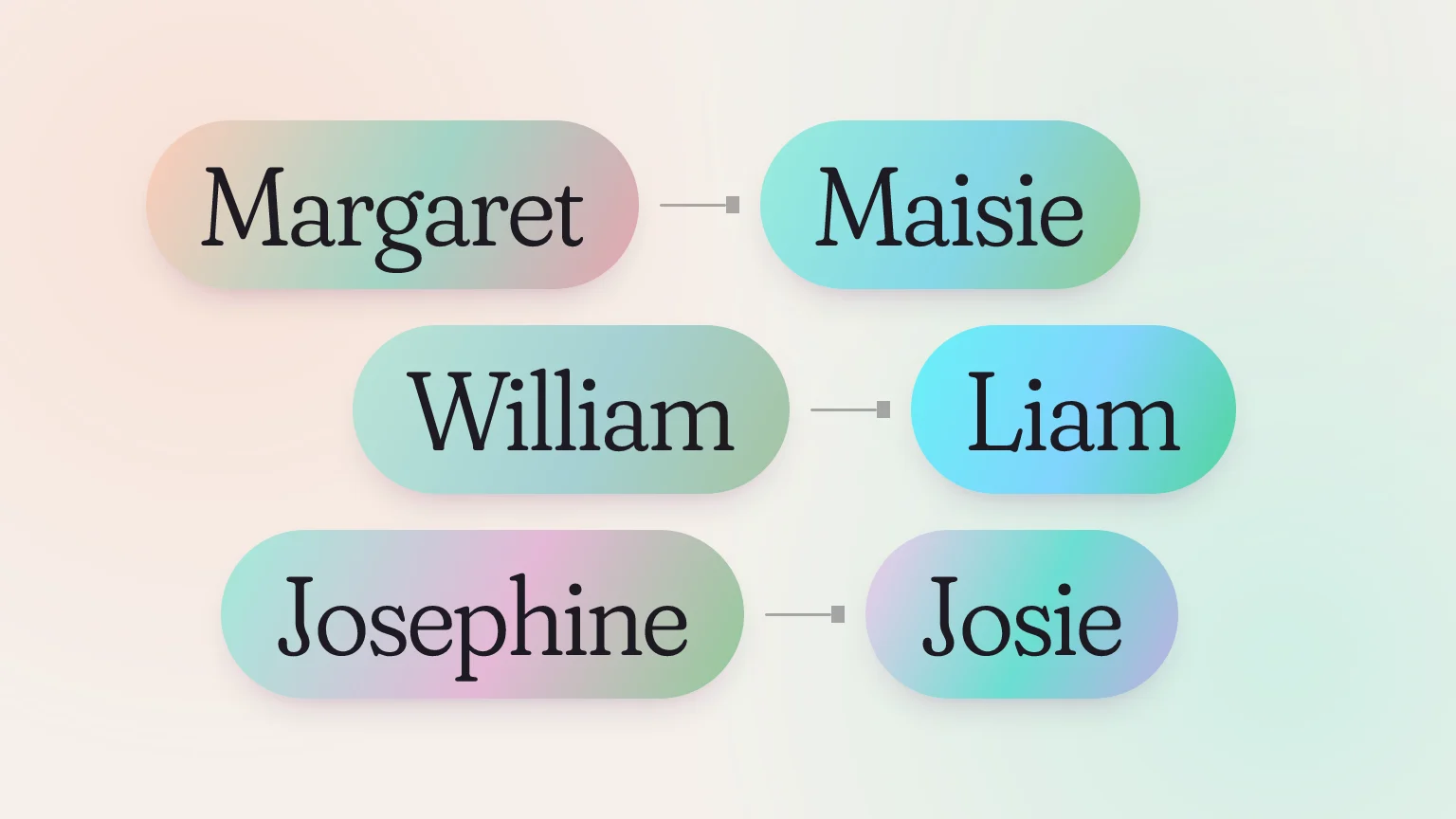
4. Use a related form: a nickname, short form or pet form. Vowel’s name pages have a section headed “Honouring a Margaret in the family” that lists these. For Margaret, it offers Maggie, Margot, Maisie and Greta. For William, it offers Will and Billy, and Liam, the Irish short form. For John, Jack and Jon.
5. Use an equivalent from another language. This works well for families with roots abroad. John has many: Vowel’s data includes Ian, Sean, Jean, Giovanni and Juan, all forms of the same name, and each has its own page: Ian, Sean, Jean, Giovanni and Juan. Our guide on names that work in two languages goes further.
6. Use the feminine or masculine form. A grandfather named George can be honored by Georgia. Joseph leads to Josephine, Michael to Michaela and Charles to Charlotte or Caroline. This is a common route when the family name belongs to the other gender.
7. Echo the meaning, the surname or the initial. Margaret means “pearl,” so Pearl honors her in meaning without being her name. A maiden name or a mother’s surname can become a first or middle name, as Lamaze notes. And an initial alone can be a quiet nod: a middle name that starts with her letter.
When the name has gone out of fashion
Honoring a name is easier when it is on its way back. Eleanor and Hazel were popular a century ago and are climbing again. The name that peaked in your family’s generation may not. Linda was given to about 1 in 29 girls in the 1940s, and in 2025 it went to only 294 girls. Ethel was about 1 in 71 in the 1890s and went to 34 girls in 2025.
A name that rare is not a problem, and you may like how unusual it is. But it asks a bit more of the child, who will spell it for people, and a bit more of you, who will need to explain it. If that worries you, the related forms in option 4 can give the same connection with an easier road. The curve on each name page tells you where a name stands today. If you are wondering whether a name will feel dated, see how popular is too popular.
Two families, one baby
When both sides of the family hope to see a name, the honoring can become a negotiation. A few ways out:
- One first name, one middle name. Choose the first name from one side and the middle from the other.
- One now, one later. Swistle’s discussion mentions saving a name for a future sibling, which suits a family that hopes for more children.
- A shared form. Look for an equivalent or nickname that both sides can claim. A name like Margot could be the French side’s Marguerite and the English side’s Margaret.
Keep this decision between you and your partner until you have it. If you struggle, how to agree on a baby name has a method.
Check the name you want to honor
A name that is beloved in your family can carry other meanings outside it. Look up its associations, its likely nicknames and how it reads on a birth announcement. The test-drive steps in how to test a baby name before you decide apply to a family name as much as to any other. If the person is living, you might also ask what they would like. Some people love the idea, and some would rather not be a namesake.
If you want to look at your own family names with fresh eyes, take the style quiz and see which names it places near them.